Review Hadestown Teen

Review by Sarah Lockyer of

Hadestown Teen

Platform Theatre School

Studio Theatre Ballakermeen

21-22 March 2026

Hadestown is a compelling and challenging musical by Anaïs Mitchell which sets the ancient myths of Orpheus and Eurydice, and Hades and Persephone, in a haunting post-apocalyptic world. It is essentially a love story but explores larger issues of power, exploitation and the resilience of the human spirit through the medium of folk music, jazz, and blues.

In the musical, Orpheus, a poor young musician, travels to the underworld to rescue Eurydice, a destitute woman he has fallen in love with. Hades has lured her there by promising to meet her basic human needs of food and shelter, but Hadestown turns out to be a hellish underground industrial landscape where nameless souls toil endlessly, building a wall that traps them inside as well as keeping others out. Moreover, the growing tension between Hades and his wife Persephone, representing the seasons and natural order, has repercussions for the worlds above and below.

In this ambitious all-female production, every aspect of the acting, music and choreography, as well as the superb staging, drew the audience inexorably into a world of fantasy and nightmare, where tenderness and humour rubbed shoulders with seduction and horror.

The starkness of the black studio stage provided the perfect backdrop, and basic furniture was used imaginatively in various ways, providing different acting levels and suggesting a range of locations. The red chair used by Hermes as narrator immediately suggested a hellish setting, but her microphone stand also added to a basement jazz club feel, as did her compere-style outfit. The steam-punk costumes of the Fates were perfect as they seemed to shift from cabaret performers to new-age witches. All the costumes worked effectively, from Persephone’s fur coat to Hades’ corporate three-piece suit and the timeless, peasant-like, shirt and jeans of Orpheus. Lighting made a powerful contribution to the contrasting settings of the world above and the underworld, with its threatening red glow and the creative use of the workers’ head lamps as spotlights, used to great effect at the climax of the action, when Orpheus is trying to lead Eurydice home.

The live musicians brought the wonderful and memorable score to life. They moved effortlessly from jazz to blues to folk ballad, reflecting the shifting moods of the play. More opera than musical, the show delivers all the dialogue through song, placing extraordinary demands on the young performers who rose to the challenge admirably. Their acting was convincing and assured, and they expertly conveyed their characters through their movement and dancing as well as through song, whether in the creatively choreographed group numbers such as Why We Build the Wall or in accomplished solos and duets like Come Home With Me and Hey, Little Songbird.

Lucinda Musson as Hermes acted as our narrator and guide with maturity and poise, from the opening number Road to Hell, staying at all times in character as she watched the action unfold inexorably. Also commenting on proceedings as well as captivating and enthralling the central characters were the Fates, marvellously co-ordinated but clearly differentiated in terms of personality by Caitlyn Hampson, Seren Kirkpatrick and Scarlet Brophy. Orpheus was played by Rosie Bullough, who brought out the youth’s naivete and idealism beautifully, and we felt sympathy for both him and Eurydice, acted by Alexis Wilson, whose vulnerability was palpable. Their relationship was convincing and moving. Kathryn Harris’s portrayal of Persephone was full of sass and attitude, as she swept onto the scene, hip flask in hand, and her transformation to disillusionment and numbness while in the underworld was clever and convincing. Samantha Winstanley brought to her role as Hades great presence and strength as a despotic ruler; she also conveyed his changing emotions powerfully, especially when he fell under the spell of Orpheus’s song. The Chorus (Allysandra Pataray, Izzy Bullough, Lucy Morris and Polly Davies) showed remarkable versatility in their singing and movement, for example their miming of building the wall in Hadestown.

There were many memorable aspects of this dynamic show, including the welcome reprises of songs such as Way Down Hadestown and Wait for Me, and how the story started over again at the end, reminding us that the Greek myths were a way to explain the turning seasons and the cycle of life. Hadestown was a complete theatrical experience, entertaining and intriguing the audience, making them laugh and moving them to tears, and leaving them pondering the nature and power of love in a harsh world.

Congratulations to the Musical Director Heather Daykin, to James Barclay for Sound and Lighting, to Choreographer Emily Lally and to Leandra Lawler who directed this talented young cast, helping them to create such a powerful piece of theatre.

Winners of MADF Festival of One Act Plays

The Manx Amateur Drama Federation our 2026 Festival of One Act Plays at the Erin Arts Centr has come to an end, all too soon.
Saturday 14th March saw the awards presented, see below for the listing.

WALKER FAMILY AWARD – Best Newcomer Me, My Monsters and I – Stage Door Academy


SURE MOBILE AWARD – Best Use of Sound & Lighting Lockdown – Elite Theatre Arts

Nominations:
Little Dolls – High Horse Productions
Theodora – Starling Crew

DAPHNE CLARK MEMORIAL TROPHY – Best Comedic Moment Roast Dinner – Service Players

Nominations:
Janet and John – Service Players
Theodora – Starling Crew
Matter of Husbands – Cobbled  Heights

NADINE TALBOT AWARD – Best Dramatic Moment Janet and John – Service Players

Nominations:
Parallels – Rushen Players
Theodora – Starling Crew
Little Dolls – High Horse Productions
Lockdown – Elite Theatre Arts
Blood of the Lamb – Rushen Players

OLGA GRAY AWARD – Best Youth Actress Daisy Maddocks – In Juliet’s Garden – Stage One Drama

Nominations:
Emily Furner – Me, My Monsters and I – Stage Door Academy
Eva Macauly – Lockdown – Elite Theatre Academy
Maddie Wood – In Juliet’s Garden – Stage One Drama

MARK CLIFT TROPHY – Best Actor Thomas Iain Dixon – Theodora – Starling Crew


Nominations:
Steve Blower – Parallels – Rushen Players
Bernard Wood – Janet and John – Service Players
Tom Cain – Roast Dinner – Service Players
Toby Smith – Roast Dinner – Service Players

STAN WOOLLOCK TROPHY – Best Youth Actor Oran Molloy – Lockdown – Elite Theatre Arts


Nominations:
Flynn Gartside – Lockdown – Elite Theatre Arts

JEAN C WEBB AWARD – Best Actress Ailsa Harrop – Blood of the Lamb – Rushen Players


Nominations:
Rachel Martin – Janet and John – Service Players
Gemma Varnon – Theodora – Starling Crew
Megan Hills – Little Dolls – High Horse Productions
Lisa Smith – Roast Dinner – Service Players
Kim Childs – Roast Dinner – Service Players
Laura Jones – Matter of Husbands – Cobbled Heights
Robyn Hughes – Blood of the  Lamb – Rushen Players

JOHN BOWRING TROPHY – Best Director in Youth Plays Jacqui Hawkes – Stage One Drama


CAINE FAMILY TROPHY – Best Director in Festival Sarah Lockyer – Blood of the Lamb – Rushen Players


CYRIL SPENCER TROPHY – Best Youth Play in Festival In Juliet’s Garden – Stage One Drama


SERVICE PLAYERS & CAINE FAMILY PRIZE – Runner Up Best Play in Festival Roast Dinner – Service Players


NORTHERN ARTS ROSE BOWL – Best Play in Festival Blood of the Lamb – Rushen Players

 
Finally our sincere thanks to our GODA Adjudicator, Sue Doherty, who not only enlightened us with her extensive knowledge and experience, but also entertained us with anecdotes from her life in Drama. 

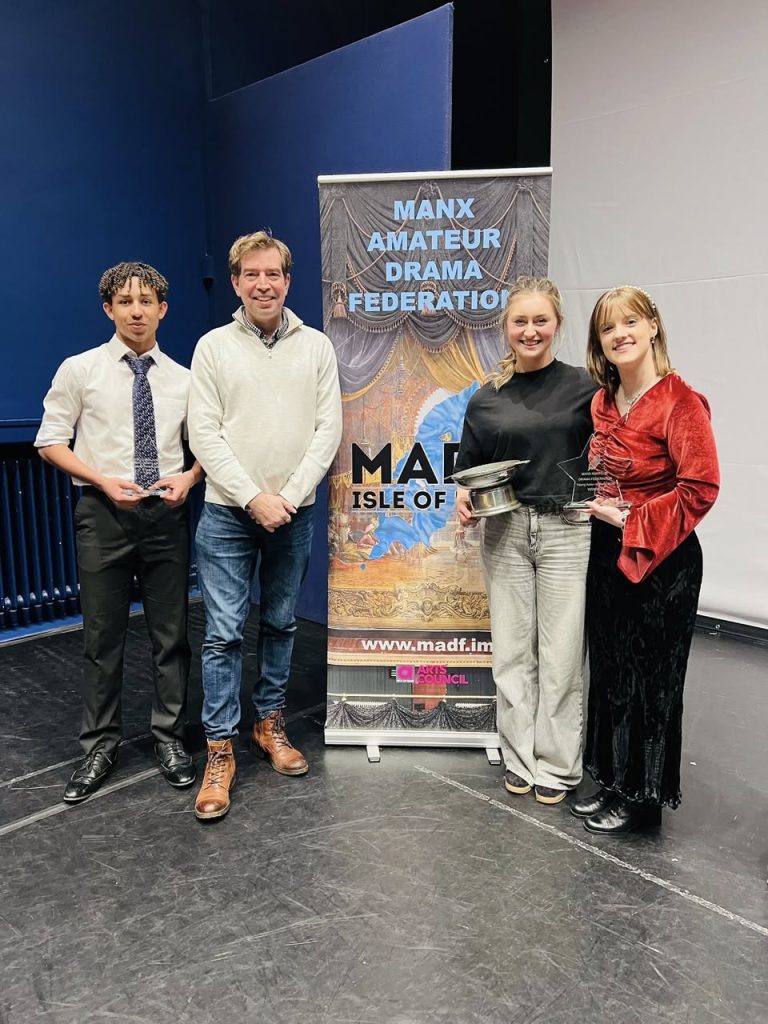
RESULTS – Young Actor of Mann 2026

Young Actor of Mann 2026 – Results Announcement

What an incredible day at the Studio Theatre, Ballakermeen for Young Actor of Mann 2026.

For the first time in 20 years, the competition has produced a joint 1st place, with adjudicator Edward Bennett unable to separate the performances.

Joint Winners

Maddie Wood and Emma-Louise Taylor

Runner Up

Womo Holden

A huge congratulations to all performers who took part and helped make the day such a fantastic celebration of young talent.

Thank you to everyone who supported the event at the Studio Theatre, Ballakermeen.

Full round-up of the One Act winners and the Chairman’s summary will follow shortly

Day 4 MADF Festival of One Act Plays

Review of Saturdays Plays

By Anthony Lawler

The final evening of the festival offered two very different but equally compelling pieces of theatre, bringing the event to a thoughtful and entertaining close. The first play, A Matter of Husbands by Ferenc Molnár, performed by Cobbled Heights and co-directed by Laura Jones and Kathryn Ellen Cawte, delivered a witty and engaging comedy of suspicion and misdirection.

The story centres on a young wife convinced that her husband is in love with a famous actress and, determined to uncover the truth, waits outside the stage door before eventually confronting the actress in her dressing room.

The set made effective use of period furniture, with a centrally placed door separating the outside area from the dressing room and clearly defining the playing spaces. Laura Jones, as the self-assured Famous Actress, brought calm confidence and sharp comic timing to the role, while Kathryn Ellen Cawte, playing the earnest young wife, delivered a performance full of emotional intensity, particularly during her dramatic breakdown which became one of the standout moments of the play.

The dialogue moves briskly between accusation and rebuttal as the actress cleverly twists the narrative in her favour, culminating in the reveal that the supposedly unfaithful husband has been hiding in the room all along, leaving the audience in no doubt where the truth really lies. Molnár’s elegant language was well handled, and the additional monologues written by the directors blended seamlessly with the original text, providing several gentle laughs that were warmly received by the audience.

The second play of the evening, Blood of the Lamb by Arlene Hutton, was presented by Rushen Players and directed by Sarah Lockyer, shifting the tone dramatically to a powerful and thought-provoking contemporary drama.

The play explores the complex legal and moral implications of legislation in Texas that requires a deceased fetus to be carried to term as an unborn citizen of the state. The staging was deliberately minimal, allowing the focus to remain firmly on the dialogue between the two characters. A simple set consisting of a table, laptop and two doors created a stark institutional setting, reinforced by sterile white lighting that reflected the clinical environment of the story.

Robyn Hughes, as Nessa, and Ailsa Harrop, as Val, delivered a compelling two-hander filled with sharp dialogue and emotional depth. Hughes portrayed Nessa’s confusion, fear and growing desperation as it becomes clear that her medical emergency forced the flight she was on to divert to Texas, where she lost her baby but is legally unable to leave while the body remains inside her.

Harrop’s portrayal of Val, a lawyer tasked with representing the legal rights of the unborn child, was equally strong, with a convincing Texas drawl and a nuanced performance that captured the character’s internal struggle between professional duty and personal morality. As the story unfolds, Val grapples with both the complexities of new legislation and her own past decisions, ultimately reaching a point where she chooses to help Nessa despite the legal consequences. While the subject matter is serious and deeply current, the script allows moments of subtle humour that offered the audience brief relief from the intensity.

The evening brought a fitting close to four nights of varied and engaging theatre. Across the Festival audiences experienced a wide spectrum of work, from light-hearted comedy to powerful contemporary drama. The inclusion of three youth performances earlier in the week added further variety, with the youngest performer taking to the stage at just eight years old. Throughout the Festival, adjudicator Sue Doherty provided thoughtful and structured feedback to all participating companies, offering valuable insight for directors, writers and performers alike. Her detailed adjudications were clearly appreciated by participants and remain one of the most valuable aspects of the festival experience.

Day 3 MADF Festival of One Act Plays

Review of Friday’s Plays

by Sarah Lockyer

Tonight, we welcomed three youth groups to the One Act Festival and a sold-out auditorium. We were delighted that Lady Lorimer and Port Erin Commissioners were present to witness their talents on display in three
very different plays.

Me, My Monsters and I by Grey Pratt

The Stage Door Academy

In this play, the monsters that emerge at night are not just under the bed but also in the head of Kid (Emily Furner): they represent all the bottled-up emotions that the nameless protagonist feels after the death of her sister. Kid learns that simply ignoring these personified negative emotions, including Anxiety (Hettie Furner), Pain (Poppy Pearson) and Loss (Evelyn Stubbs), is not effective, as they will continue to feed off each other. Rather, Kid has to process and work through the emotions in order to grow and come to terms with what has happened.

Grieg’s ominous music ‘In the Hall of the Mountain King’, rustling sounds and shadowy figures moving around set the tone effectively at the start. The light changed from sharp focus on the bed to reveal the whole bedroom, complete with brightly coloured bean bags, scattered toys and strewn clothes—and monsters in pink pyjamas! Kid was dressed in contrasting red, perhaps suggesting something more real and substantial.

Emily Furner certainly performed the central role with confidence, delivering lines with clarity and convincing emotion. When Kid eventually recounted the details of the car accident that led to her sister’s death, you could have heard a pin drop.  It is not easy to play an abstract concept such as Judgement (Elodie Marshall), Failure (Tatum Erasmus) or Change (Lillian Roberts), but all of the emotions were acted most effectively, with different gestures and tones of voice in keeping with their roles. We really felt the effect Envy (Emmanuelle Deveaux), Pain and Depression (Taryn Harding) and each of their fellow monsters were having on Kid.

Direction ensured that the monsters closed in on Kid at times, surrounding her and making her feel trapped, while at other points in the play they approached Kid individually, to reason with or to taunt her, sitting next to her on the bed. There was also humorous interplay among the monsters, who shifted from arguing and challenging each other to joining forces as Kid came to terms with them. In the end, Kid literally embraced each of her emotions in turn, showing how much she had learned and grown, and leaving us hopeful for her future.

Stage Door are to be congratulated for an accomplished and memorable performance. As the youngest group, and one taking part in the One Act Festival for the first time, they should be very proud of what they achieved, and we look forward to seeing them perform again in the future.

Lockdown by Douglas Craven

Elite Theatre Arts

It was thirty years ago today that sixteen pupils and one teacher lost their lives in Dunblane, in the deadliest mass shooting in British history; this tragic anniversary gave an added poignancy to tonight’s performance of Lockdown. In this play, high school students wait in a dark classroom, not knowing if it is a drill or if there is a real emergency.  When one girl rushes out of the room in hysterics and the teacher follows, the remaining students have to decide whether to stay put or venture out. The audience is challenged to think about what they would do in a terrifying situation that has become all too real and frequent in the modern world.

The opening music ‘I don’t like Mondays’, inspired by a teenage shooting spree at a school in San Diego, was a fitting introduction to the setting and story of the play. The lights on the stage barely came up, just enough for us to see a simple classroom setting, with teenagers in school uniforms cowering under desks, while their teacher tried to keep them – and himself – calm. Flashes of light from a lighter and a mobile phone reminded us they were waiting in darkness, making their situation all the more tense. The passing minutes and hours were punctuated by booming, repetitive announcements that revealed nothing about what was really going on beyond the door that loomed at the back of the stage, and a fire alarm causing shock and panic.

The acting was strong throughout. Once the teacher left, the characters shifted from their student personas to their truer selves, and the actors achieved this well, delivering their dialogue convincingly and using gesture and body language to suggest their relationships and personalities. The stage was used effectively, for example when the students took over the teacher’s chair and desk, and when they came forward to express their views with varying degrees of confidence appropriate to their clearly different characters. The tense but monotonous situation was given a dynamic quality by changes of pace and injections of humour. We were reminded that these were just ordinary teenagers trapped in an extraordinary situation.

The ending of the play was chilling: footsteps were heard, the corridor lit up, someone started banging on the door. Then blackout, and the audience was left to imagine what happened next and to echo a question in the play ‘When did people start hunting children?’ Congratulations to the group for a powerful performance of a demanding piece of theatre. Newcomers to the Festival, they made an excellent first impression, and we hope they return in the future.

In Juliet’s Garden by Juith Elliot McDonald

Stage One Drama School

Shakespeare’s heroines gather for a meeting, hoping the Bard himself will show up, as they want to update their plots. Their conversation challenges the hand that they have been dealt by Shakespeare in terms of their roles, while his agent -complete with clip board – gives them a different perspective. Juliet’s Nurse (Penny Lavery) reminds us how women over the centuries have reacted to their characters and the positive difference they have made. At the end of the play, the heroines realise that, just maybe, Shakespeare has actually provided a voice for the ‘strong, rational, complicated women’ they want to be, if they can find it and share it with their audiences.

The meeting place is a lovely garden in Verona: a floral trellis and garden furniture set the scene, with birdsong and fountain sounds adding to the ambience. Lighting gave the appropriate feel of a warm summer’s afternoon. Costumes ranged from sumptuous period dresses to modern suits, a reminder of all the different ways Shakespeare’s plays have and can be performed. Each outfit suited the particular character, from Ophelia’s (Bella Kirkwood) boho look to the Renaissance velvet gown of Desdemona (Maddie Wood). The effect was a colourful collage contrasting well with the business attire of Jacqueline (Morgan Braidwood) and Portia (Phoebe Cringle), which established the action firmly in the twenty-first century. As did the mobile phone going off at the start of the play—part of the script this time, not a member of the audience forgetting to put theirs on silent!

The characters were convincing and clearly differentiated, and the confident acting throughout demonstrated full and subtle understanding of Shakespeare’s original text as well as the thought-provoking ideas this play explores. The production benefited from lively presentation, including articulate dialogue, well-delivered Shakespearean speeches, effective movement and gesture, and even a delightful rendition of the ‘stabbed, smothered and drowned’ song!

The success of the play depends on contrasts: between Shakespearean and modern times, between all the different female characters, and ultimately between their sense of themselves at the start and at the end of the piece. Humour and lightness were balanced with poignancy, as the characters slipped seamlessly into delivering lines from their respective Shakespeare plays, and we were reminded of the fate facing all these young women—and all women finding their place and influence in a man’s world.

The audience responded with enthusiasm to the engaging, witty script, delivered with energy, understanding and a delightful lightness of touch by the accomplished cast. Although the Bard never did appear, I am sure he would have approved of such an assured performance by his feisty heroines, even if he wouldn’t have considered changing their stories.

Following the three plays, with all the young actors seated around on stage,
we were treated to an interesting analysis
by Sue Doherty, our GODA adjudicator.
Sue shed light on the plays, their writing and their interpretations
for the stage by the actors and directors
This was a fascinating learning experience for both the groups
and the audience. We look forward to tonight’s comments.

Day 2 MADF Festival of One Act Plays

Review of Thursday’s Plays

by Ron Beswick

The opening play of the evening, Little Dolls, presented by High Horse Productions was a dark tale presented on a disturbingly dark stage.

Vicky (Megan Hills) is attempting to overcome her fear of darkness through sessions of counselling  with  a rather spooky counsellor John (Neil King).


This is no relationship counselling like we experienced in Parallels on Wednesday. We are in the realms of deep psychological trauma.

The stage is set in very low level lighting which John seems to insist on forcing Vicky to endure endlessly. As a comforter she has a lighter flame, of which John restricts the use. A ticking clock adds to the suspense of the session.

Vicky opens the play with a heartfelt monologue of her feelings and memories. We recognise she is a very troubled individual.

As the counselling session progresses we learn that Vicky’s trauma was the result of the rape and murder of her best  friend when, as young children, they were on a vacation retreat. The young girls, ‘little dolls’, were all asleep when an intruder attacks her best friend. John’s stage entry is perhaps a parallel to the intruder entering the girl’s dormitory.

Vicky vividly describes her feelings of guilt, fear, anxiety and obsessive behaviour. She just wants to be NORMAL. John is encouraging her to confront her fears by recalling the past trauma.

Vicky expresses her desire to stop or at least have a break, John is persuasive in her continuance of the sessions. We wonder, will she be cured by this seemingly torturous process?

Good luck Vicky, but well done High Horse Productions for a gripping drama.

Our next play, Bus 404, presented by Underwood Productions takes a motley crew of ‘tourists’ on a bus tour of the Isle of Man. The confident Girl Driver (Michelle Cain) prepares and starts her luxury coach, a wooden chair, and welcomes the assorted travellers.

With some airline style hosting and a lovely choreographed group movement the bus sets off on it’s tour. We are introduced to the passengers with little cameos and what a strange bunch they are. From the ex-war hero to the young gamer girl. Would we be happy passengers with this lot?

As the tour proceeds, just past Fairey Bridge, one of the passengers, Bonnie (Vivian Toro) is feeling ill and asks the driver to stop. Now the darkness starts, Bonnie and her partner, guess who, Clyde (Darren Webb) are set to rob the passengers of their valuables. As the hold up continues, the robbers begin to fall apart, deviating from their plan, violence ensues and Girl Driver is taken captive. As they say, no honour amongst thieves.

At the off stage sounds of violence and sexual assault, the passengers shy away from intervening except for Joe (Gonzo Galliad) who carries the communal conscience. Joe goes off to try and help. The passengers are in ‘do nothing trauma’ mode. Bonnie and Clyde abandon their heist intentions and rush off, Clyde abandoning the spoils of the robbery.

A dishevelled Girl Driver reappears and breaks down but slowly recomposes herself and reverts to professional tour guide persona. Handing back the stolen items to the passengers she prepares and drives the bus away, leaving the vacant chair and a battered Joe on stage.

We are left questioning why was Joe rejected by Girl Driver, who attacked her – Clyde or Joe?

The poignant ending sees Joe breaking down alone on the stage as the local radio announces that a tour bus has gone over the cliff edge.

Thank you Underwood Productions for an entertaining new play with many different emotions.

Our final play of the evening, Roast Dinner, presented by Service Players starts with another driving experience with, two chairs this time, as young lovers, Carrie (Kim Childs) and Ben (Tom Cain) drive  off for lunch with Mother (Lisa Smith).

We start to view Ben as a bit of a ‘know it all’ criticising Carrie for her driving skills, when it is soon revealed that Ben is really an Alien. Ben’s controller on Earth Commander Snootyparp (Toby Smith) soon appears with his invisibility cloak engaged. We have a series of three way conversations between these two and Ben’s, human, golfing friend, Karl (Ben Davenport) to great amusement.

It appears that there is a ‘Grand Plan’ about to be implemented which involves the extermination of all life on Earth and take over by the Aliens. This is disturbing news to Ben as he is in love with Carrie and wants to save her.

Carrie and Mother have the usual mother daughter friendly/antagonistic relationship, but Mother is fond of Ben. They all sit down to Sunday lunch, including Karl with Commander Snootyparp observing from his cloaked position.

As the doom minutes approach and oblivion looks like the ending (shades of Theodora) it appears that Mother is also an Alien (different species) and Mother’s previous relationship with a human brought about Carrie.


However Mother and Carrie are more powerful aliens than Snootyparp and Mother has been able to see Snootyparp all the time. She takes romantic advantage of Snootyparp, leaving a disheveled Snootyparp in a state of exhaustion at the Sunday dinner table.

Roast Dinner has shades of The X Files meets Hitch Hikers Guide to the Galaxy. Great comedy, thank you Service Players for bringing another new IOM play to the stage.

Day 1 MADF Festival of One Act Plays

Review: Janet and John

By Michael Pearcy

Performed by: The Service Players

Review by: Anthony Lawler


The opening play of the evening, Janet and John, invites the audience into the private world of a long-married couple as they reflect on the moments that have shaped their lives together. Through a series of monologues, memories, and revelations, the play explores love, regret, difficult choices, and the quiet ways relationships endure over time.

Set

The staging was simple but effective. A minimal selection of props was used to create the couple’s living room, immediately grounding the audience in the domestic setting of the story. This understated approach allowed the focus to remain firmly on the characters and their shared history rather than on elaborate scenery.

Lighting and Sound

Lighting was used particularly well throughout the piece. Spotlights isolated each character as they transitioned between memories and present-day reflections, helping guide the audience smoothly through the shifting timeline. These moments added clarity to the narrative and created a strong sense of intimacy during the characters’ personal monologues.

Performances

The performances were central to the success of the play.

Janet opened the piece with a strong and engaging monologue, addressing the audience directly as she puzzled over John’s unusual decision to take her out for dinner on a Friday night. Her conversational style immediately drew the audience in and established a tone that continued throughout the performance.

John’s responding monologue offered early hints that something significant lay behind this sudden change in routine. As the story unfolded, his reflective moments added layers to the narrative, gradually revealing the emotional weight behind the evening’s events.

Story

The script balances humour with deeply reflective themes. There are several well-timed comic moments that drew genuine laughter from the audience, providing welcome relief between the more serious reflections.

As the play progresses, we gain a vivid sense of the couple’s life together. Their story touches on difficult and often unspoken subjects, including the agonising decision of whether or not to have a child, followed by the devastating loss of a baby. The emotional impact of that loss lingers throughout the narrative, particularly in light of the earlier conversation about abortion.

The story then moves toward the present evening, initially leading the audience to believe the pair are heading out to discuss the purchase of a canal-side café. Along the way we learn of Janet’s past affair with her French teacher, an experience that meant far more to her than John ever realised. Although John never knew the truth, there remains a quiet suggestion that he may have long suspected something was amiss.

Direction

The direction made effective use of stillness. At several points the actors froze in place, allowing the stage picture to hold while the narrative shifted between past and present. These quiet transitions worked well in signalling changes in memory without breaking the flow of the play.

Writing

The script itself is thoughtful and well constructed. It weaves reflective moments with gentle comedy, giving the characters warmth and relatability. The use of flashbacks is particularly effective, allowing the audience to piece together the couple’s shared history bit by bit.

The final reveal provides a memorable conclusion. The reason for John’s invitation to dinner turns out to be deeply personal: he has named a new Eddie Stobart lorry after his wife. It is a surprisingly tender gesture, bringing the story full circle and highlighting the enduring bond between the two characters.

Audience Reception

The play was warmly received, with clear engagement from the audience throughout. Laughter at the comic moments and attentive silence during the more reflective scenes showed that the piece successfully balanced humour with emotional depth.

Overall, Janet and John is a thoughtful and engaging exploration of a relationship shaped by life’s difficult choices and enduring affection, delivered through strong performances and confident, understated staging.


Review: Parallels

By E. Wood & N. Kinley

Performed by: Rushen Players

Review by: Anthony Lawler


The second play of the evening, Parallels, explores the complicated intersections between personal relationships and the unseen emotional baggage people carry into them. Moving between a troubled marriage and a counselling room, the play examines alcoholism, family trauma, and the ways past experiences quietly shape present behaviour.

Set

The set design made excellent use of the stage space. Through clever dressing and positioning, two distinct locations were created: the couple’s home and the therapist’s office. The use of a split-stage layout worked particularly well, visually bringing the audience into both worlds at the same time and reinforcing the idea that the private struggles of home life run parallel to the conversations happening in therapy.

Lighting and Sound

Lighting supported this structure effectively. Spotlights were used to divide the stage and clearly distinguish between the two settings. These shifts helped guide the audience through the transitions without interrupting the rhythm of the play.

Story

The play balances humour with serious subject matter. Several comedic exchanges between the couple drew genuine laughs, helping to offset the heavier themes that run through the narrative.

As the relationship begins to unravel, the couple turn to counselling, and the dynamic shifts into a series of therapy sessions. These scenes feature strong back-and-forth dialogue between the characters, allowing the audience to see both sides of the marital breakdown.

A particularly effective device is the counsellor’s use of the fourth wall. By stepping out of the scene and addressing the audience directly, she reveals her own thoughts and reactions to the session as it unfolds.

Gradually, it becomes clear that the counsellor herself is dealing with unresolved issues from her own past, particularly surrounding her alcoholic mother. These reflections add another emotional layer to the story.

One of the more moving moments occurs when the Serena sings while recalling memories of her father. The scene reveals both her longing for him and her deep frustration that she went to work on the day he died, a memory that clearly continues to haunt her.

The play then shifts again to the counsellor’s own life at home, where she is seen speaking to her mother and expressing years of pent-up frustration. In a striking reveal, the audience learns that her mother is actually dead, highlighting just how deeply these unresolved emotions continue to affect her.

By the final counselling session, the couple appear to have made progress and found some peace with their pasts. However, the play leaves us with the suggestion that while the couple may have confronted their ghosts, the counsellor herself is still struggling to do the same.

Direction

The direction made particularly strong use of the fourth wall, allowing the counsellor’s private thoughts and fears to be shared directly with the audience. This device helped deepen the narrative and provided insight into a character who might otherwise have remained distant.

The pacing of the piece was also well judged, keeping the audience engaged as the story moved between humour, confrontation, and emotional reflection.

Writing

The script is sharp, thoughtful, and often very funny. It manages to tackle the serious subject of alcoholism and family trauma while still providing moments of levity. The dialogue feels natural and the layered storytelling structure supports the central theme of parallel struggles within different relationships.

Audience Reception

The audience remained engaged throughout the performance. The well-timed comic moments offered relief from the heavier themes, while the emotional depth of the story ensured the play remained compelling from beginning to end.

Overall, Parallels is a well-written and well-directed piece that thoughtfully explores the echoes of family history within adult relationships, delivered through strong performances and a clever use of staging.


Review: Theodora

By Gemma Varnom

Performed by: Starling Crew

Review by: Anthony Lawler


The third play of the evening, Theodora, presents a striking and unusual premise. Set in the final moments before an asteroid is due to strike Earth, the play follows two former lovers who reunite to face the end of the world together. What begins as a reflective encounter soon becomes an exploration of unresolved emotions, past relationships, and the complicated truths people confront when time is running out.

Set

The set was very simple but highly effective. With minimal staging, the focus remained firmly on the interaction between the two characters. The stripped-back design allowed the performances and dialogue to carry the emotional weight of the piece.

Lighting and Sound

Lighting and sound were used to support the atmosphere of the play, subtly reinforcing the sense of urgency and tension that comes with the knowledge that the world is about to end.

Performances

The strength of the play lies largely in the performances of the two actors.

Mia, played by Gemma Varnom demonstrated excellent chemistry with her counterpart, creating a believable dynamic that shifted naturally between humour, nostalgia, and confrontation.

Danny played by Thomas Iain Dixon delivered a convincing portrayal, grounding the character’s emotional shifts and frustrations in a way that made the relationship feel authentic.

Story

The story centres on a pact between the two characters to be together at the end of the world. Their reunion becomes a moment to confront old memories and unfinished conversations.

As the asteroid approaches, the pair explore their fears, their family dynamics, and the strange reality of the world around them as society braces for its final moments. This shared reflection gradually leads them back to their own past relationship.

They begin to revisit how things once were between them, recalling old feelings and missed opportunities. However, nostalgia soon gives way to arguments as old frustrations resurface. Despite this tension, moments of reconciliation follow, highlighting the complexity of their shared history.

One particularly memorable moment involves an attempt at synchronous dancing, a hilariously awkward sequence that brought a great deal of laughter from the audience and provided a welcome moment of levity in the midst of the darker themes.

The tone then shifts again as deeper emotions surface. The male character expresses his long-held belief that they could have had a serious relationship together, along with his anger that it never happened, a frustration he places largely at her door.

In the final moments, the play takes a darker and more serious turn. The confrontation escalates into a physical attack, forcing the female character to defend herself and finally speak honestly about how she truly feels, before throwing Danny from the apartment to face the end on his own.

Just as this emotional climax unfolds, the inevitable happens, the asteroid strikes, bringing the story to its abrupt and powerful conclusion.

Direction

The play was well directed, making effective use of both the limited set and the available stage space. The simplicity of the staging allowed the emotional intensity of the performances to remain at the forefront.

Writing

The script is an original and engaging piece of writing. It moves at a strong pace while still giving the audience time to absorb the emotional developments within the story. The dialogue is sharp, often funny, and occasionally deeply reflective.

The use of comedy throughout helps balance the darker themes, creating a play that is both entertaining and thought-provoking.

Audience Reception

The audience remained fully engaged throughout the performance. There were several genuine laugh-out-loud moments, balanced with audible gasps as the tension in the story built toward its conclusion.

Overall, Theodora is a bold and imaginative piece that blends humour, nostalgia, and emotional confrontation within the extraordinary setting of the world’s final moments.

Miss Fozzard Finds Her Feet & Carry On

Erin Arts Centre 6th March 2026

Miss Fozzard Finds Her Feet from Talking Heads by Alan Bennett

Performed by Stephanie Gray, directed by Stephen Craige (Legion Players)

Carry On by Jennie Webb

Performed and directed by Sarah Lockyer (Rushen Players)

Sound and lights Ron Beswick

Review by Barnaby Lockyer

Miss Fozzard eventually finds her feet while Beth prepares herself for ‘the next leg of her journey’. So it is that a play on body parts features in both of these clever monologues.

Alan Bennett is well known for his Talking Heads, exploring human eccentricity with precision and wit; LA-based playwright Jennie Webb writes what she calls ‘domestic absurdism’, focusing on women’s experience—as does Bennett.

Legion Players bring gentle background music to Bennett’s work and break up the narrative by means of subtle movement and convincing mime. Miss Fozzard is at home to us, initially in slippers, and we the audience felt increasingly at home with her in her dignified, clear but often laugh-out-loud performance, the delivery of lines focusing exactly as it should on the pleasures of mischievously playful language and the gradual disclosure of character and relationships. Costume and props aided this development most effectively. It seemed appropriate under the circumstances that perky peony buds should replace drooping roses in a vase on the table, and the unboxed scarlet high heels revealed at the end of the piece confirmed Miss Fozzard’s emancipation.

Rushen Players’ Carry On featured a piece of red luggage and no other prop, but expressive acting and gesture to convey parts of the body associated with the poetic images of lost friends and relatives remembered were not only relatable but also powerfully moving.

The event was a fundraiser for the Alzheimer’s Society, in memory of Susie Beswick, a stalwart of drama on the Island. It took place just over a year after a staging of Under Milk Wood at Erin Arts, which paid tribute to Susie’s life and love of theatre, and brought together her family and friends, including those she had worked with over the years. I know she’d have also appreciated the language and poignant humour of tonight’s plays.

Guys and Dolls

By Choral Union

Gaiety Theatre

February 2026

Review by Leandra Lawler

Choral Union’s production of Guys and Dolls was a lively and colourful evening of musical theatre, full of energy and charm. From the moment the curtain rose, the stage was brimming with vibrant costumes and a strong ensemble presence that brought the streets of New York to life.

The costumes were a real highlight of the show — bold, bright, and perfectly in keeping with the spirit of the production. They added visual flair to every scene and helped create a wonderfully immersive atmosphere. There were also some genuinely laugh-out-loud moments, with the cast delivering the humour confidently and keeping the audience thoroughly entertained.

Evie Skillicorn and Damien Kneale both sang beautifully throughout the evening. Their vocals were polished and expressive, and they shared fantastic chemistry on stage, bringing warmth and sincerity to their roles. Their connection felt natural and engaging, drawing the audience into their story.

Simon Fletcher brought great character to the role of Nathan Detroit, capturing both the humour and the underlying vulnerability of the part. Alongside him, Natalie Smith was a delightful Adelaide, balancing comedy with heart. Their on-stage relationship was thoroughly entertaining — full of sharp timing, playful tension, and genuine affection — making their scenes together a real joy to watch.

Overall, it was an enjoyable and spirited production that clearly showcased the dedication and talent within Choral Union. A colourful, entertaining night at the theatre that was met with well-deserved appreciation from the audience.